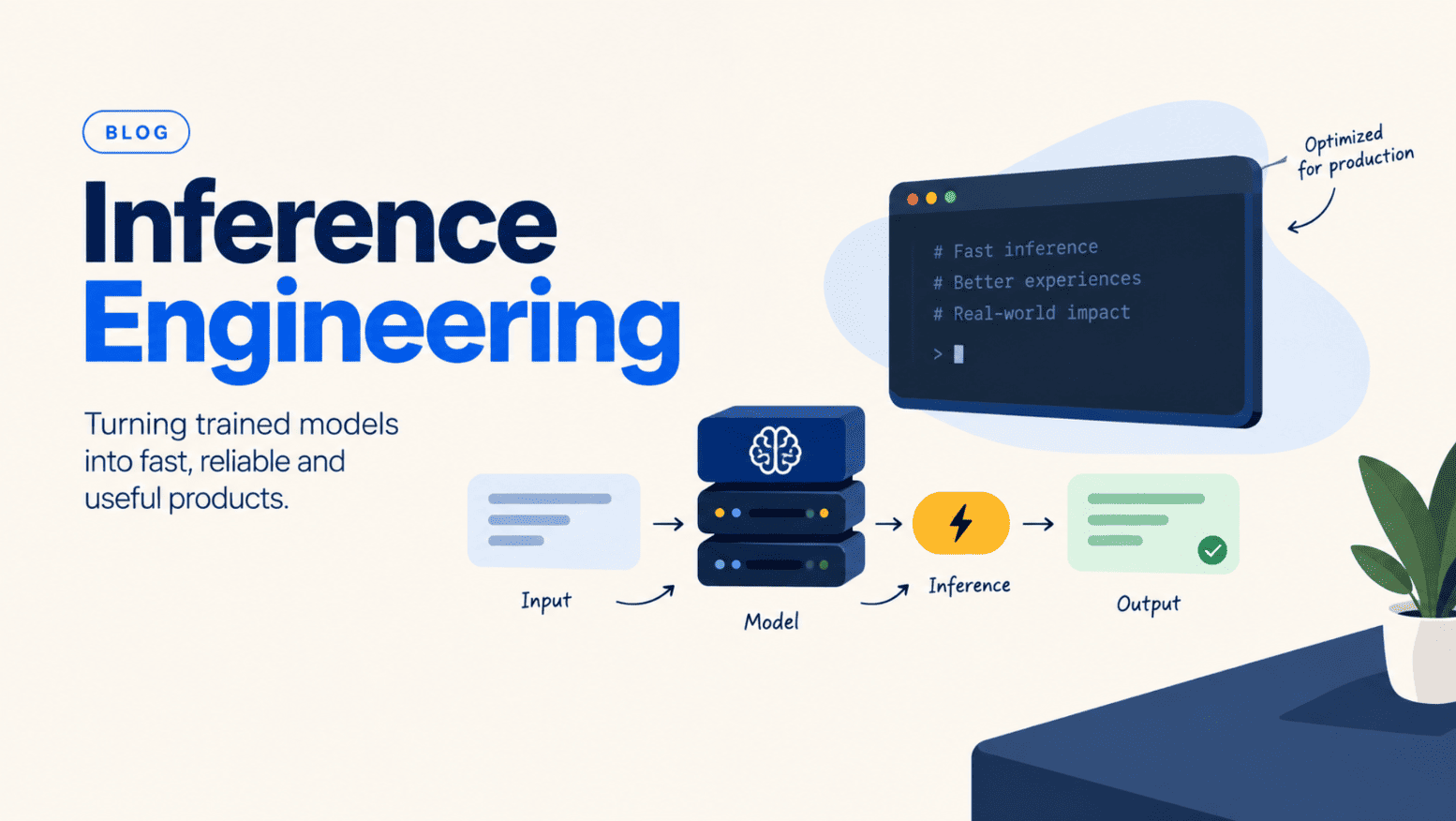
WHY INFERENCE ENGINEERING IS THE MOST UNDERRATED CAREER PATH IN AI RIGHT NOW
If you're an engineer looking at the AI industry and wondering where the compensation and technical leverage sit, the answer isn't "become an ML researcher." Researchers train models. Inference engineers make those models usable in production, and there are 20x fewer of them than the industry needs.
In 2026, senior inference engineers at frontier labs (Anthropic, OpenAI, Google DeepMind, Meta AI) clear $500K-$900K total compensation. Applied inference engineers at Series B-D AI companies routinely earn $250K-$450K. Contract inference engineers charge $250-$500 per hour.
The reason for the premium: model training is centralized at a few labs. Model serving is decentralized across every company using AI. Every company using AI needs inference expertise. Very few engineers have it.
I'm a 10-year software engineer. Inference engineering is one of my Season 1 Side Quests, because it sits at the intersection of every skill I care about: systems performance, applied ML, and hard technical problems that compound.
This article is the roadmap I built for myself. If you're an engineer trying to break into this field or level up inside it, this is the path.
I'm using Edirae to retain the material as I go, because there's too much depth here to hold in working memory alone. More on that at the end.
WHAT INFERENCE ENGINEERING ACTUALLY IS
Inference engineering is the discipline of running trained neural networks efficiently in production. It sits between machine learning research (which produces the models) and systems engineering (which produces the infrastructure).
The core problem it solves: a state-of-the-art LLM might be theoretically capable, but if it costs $0.10 per query, takes 8 seconds to respond, and consumes 200GB of VRAM per instance, it's not usable. Inference engineering brings that same model down to $0.001 per query, 300ms response time, and 8GB of VRAM, without meaningful quality loss.
The subdiscipline covers roughly eight areas:
- Model optimization (quantization, distillation, pruning)
- Serving infrastructure (vLLM, TensorRT-LLM, Triton)
- Batching and scheduling (continuous batching, priority queues)
- Memory management (KV cache, PagedAttention, offloading)
- Multi-GPU parallelism (tensor parallelism, pipeline parallelism)
- Speculative decoding and caching
- Latency and cost optimization
- Evaluation and quality preservation Each area is deep enough to specialize in. Together, they define the field.
THE 8 CORE AREAS (WHAT YOU NEED TO KNOW IN EACH)
1. Model optimization
This is where you learn to shrink models without breaking them.
Concepts to master:
- Quantization (INT8, INT4, FP8, mixed precision)
- Post-training quantization vs quantization-aware training
- GPTQ, AWQ, GGUF formats
- Knowledge distillation
- Pruning (structured and unstructured)
- LoRA and QLoRA for efficient fine-tuning Reality check: most production inference in 2026 runs on INT8 or INT4 quantized models. Full FP16 inference is increasingly rare outside frontier labs. If you can't fluently work with quantized models, you're not competitive.
2. Serving infrastructure
Tools to know deeply:
- vLLM: the current open-source standard for high-throughput LLM serving. Written in Python + CUDA kernels. Understand its PagedAttention innovation.
- TensorRT-LLM (Nvidia): NVIDIA's inference stack. Higher performance than vLLM on NVIDIA hardware, more complex to set up.
- Text Generation Inference (Hugging Face): solid, well-supported, integrates with the HF ecosystem.
- SGLang: newer entrant, strong on structured output and multi-turn conversations.
- Triton Inference Server: general-purpose model serving, not LLM-specific. Pick one to know intimately. Know the other three at least well enough to explain when you'd choose them.
3. Batching and scheduling
Concepts:
- Static batching vs dynamic batching vs continuous batching
- How continuous batching solved the "long generation blocks short generation" problem
- Prefill vs decode phases
- Chunked prefill
- Priority queues for latency-sensitive requests
- Backpressure and load shedding The interview question you'll be asked: "How does continuous batching work, and why is it 10x more efficient than dynamic batching for LLMs?" If you can't answer this cold, you're not ready for a senior inference role.
4. Memory management
The KV cache is the single most important data structure in LLM inference. Learning how it works transforms your understanding of the field.
Concepts:
- What the KV cache actually stores
- Why it grows linearly with sequence length
- PagedAttention (the vLLM innovation, published in the 2023 SOSP paper)
- Prefix caching for shared conversation history
- KV cache quantization
- Cache offloading to CPU or NVMe The paper to read: "Efficient Memory Management for Large Language Model Serving with PagedAttention" (Kwon et al., 2023). This is the paper that made vLLM the dominant serving framework.
5. Multi-GPU parallelism
At the frontier, models don't fit on a single GPU. Understanding how they're split across GPUs is a distinguishing skill.
Concepts:
- Tensor parallelism (split each layer across GPUs)
- Pipeline parallelism (split layers across GPUs)
- Sequence parallelism
- Expert parallelism (for Mixture of Experts models)
- Communication primitives (all-reduce, all-gather, ring reduce)
- NCCL basics
- Bandwidth vs latency tradeoffs You will not master this in a weekend. But you need to understand the concepts well enough to reason about a serving architecture.
6. Speculative decoding
Speculative decoding is one of the most elegant ideas in inference engineering. Use a small "draft" model to guess tokens, then let the large model verify multiple tokens per forward pass.
Concepts:
- Standard speculative decoding
- Medusa (multi-head speculation)
- EAGLE (a newer, more efficient variant)
- Lookahead decoding
- Assisted generation with draft models Realistic speedup: 2-3x for well-configured setups. This is one of the highest-leverage optimizations available.
7. Latency and cost optimization
Concepts:
- Time to first token (TTFT) vs inter-token latency
- Streaming vs non-streaming
- Cost per million tokens (input vs output)
- Autoscaling for spiky workloads
- Multi-model routing (route cheap queries to small models, expensive queries to big models)
- Prompt caching (both server-side and client-side) Realistic 2026 benchmark: a well-optimized Llama-70B on 8xH100s serves 2,000-3,000 requests per second at ~100ms TTFT.
8. Evaluation and quality preservation
Every optimization risks degrading model quality. You need to measure it.
Concepts:
- Perplexity as a coarse quality signal
- Task-specific benchmarks (MMLU, GSM8K, HumanEval, MTBench)
- LLM-as-a-judge evaluations
- Regression testing pipelines
- A/B testing quantized vs unquantized models in production You cannot ship a 4-bit quantized version of your model without a measurement pipeline that catches quality drift. Learn this early.
THE 12-WEEK LEARNING ROADMAP
If you have solid systems engineering background and 10-15 hours per week, you can reach useful proficiency in 12 weeks. Longer if you're coming from application development without systems experience.
Weeks 1-2: Foundations
- Understand transformer architecture at the tensor-operation level
- Read: "The Annotated Transformer" (Alexander Rush)
- Read: "Let's build GPT" by Karpathy (blog + video)
- Run inference locally on a small model (Llama 3.2 1B) using both Transformers library and llama.cpp
- Understand tokenization, attention, KV cache in code
Weeks 3-4: Quantization
- Read the GPTQ paper (Frantar et al., 2022)
- Read the AWQ paper (Lin et al., 2023)
- Quantize a small model to INT4 using GPTQ
- Measure quality difference on 3 benchmarks
- Try GGUF format with llama.cpp
Weeks 5-6: Serving with vLLM
- Read the PagedAttention paper end to end
- Deploy vLLM on a rented H100 (or A100 if you're cost-constrained)
- Serve a 7B and 70B model
- Benchmark throughput and latency under load (use k6 or Locust)
- Understand continuous batching by inspecting vLLM's scheduler
Weeks 7-8: Multi-GPU + TensorRT-LLM
- Rent 2-4 GPU instances
- Get tensor parallelism working with vLLM
- Compare TensorRT-LLM against vLLM on the same hardware
- Understand tradeoffs
Weeks 9-10: Speculative decoding and advanced optimizations
- Read the Medusa paper (Cai et al., 2024)
- Read the EAGLE-2 paper (Li et al., 2024)
- Try speculative decoding in vLLM
- Measure real-world speedup
- Implement prefix caching for shared conversation history
Weeks 11-12: Production concerns
- Build a full serving stack with autoscaling
- Add observability (metrics, tracing)
- Implement A/B testing between two quantization levels
- Build a quality regression pipeline
- Deploy to a live endpoint with SLOs By week 12 you'll be dangerous. Not senior. But dangerous. Dangerous is enough to get hired into a role where you'll rapidly get to senior.
THE PAPERS TO READ (AND WHY)
These are the papers that define the current state of the field. Every serious inference engineer has read them.
Foundational:
- "Attention Is All You Need" (Vaswani et al., 2017)
- "The Illustrated Transformer" (Jay Alammar, blog post)
- "Efficient Memory Management for Large Language Model Serving with PagedAttention" (Kwon et al., 2023) — the vLLM paper Quantization:
- "GPTQ: Accurate Post-Training Quantization for Generative Pre-trained Transformers" (Frantar et al., 2022)
- "AWQ: Activation-aware Weight Quantization for LLM Compression and Acceleration" (Lin et al., 2023)
- "SmoothQuant: Accurate and Efficient Post-Training Quantization for Large Language Models" (Xiao et al., 2022) Speculative decoding:
- "Fast Inference from Transformers via Speculative Decoding" (Leviathan et al., 2023)
- "Medusa: Simple Framework for Accelerating LLM Generation with Multiple Decoding Heads" (Cai et al., 2024)
- "EAGLE-2: Faster Inference of Language Models with Dynamic Draft Trees" (Li et al., 2024) Serving:
- "Orca: A Distributed Serving System for Transformer-Based Generative Models" (Yu et al., 2022) — the continuous batching paper
- "SGLang: Efficient Execution of Structured Language Model Programs" (Zheng et al., 2023) Long context:
- "FlashAttention-2: Faster Attention with Better Parallelism and Work Partitioning" (Dao, 2023)
- "Ring Attention with Blockwise Transformers for Near-Infinite Context" (Liu et al., 2023) You don't need to read them all in week 1. Space them across the 12 weeks. Read one, digest it, put its key concepts into your retention system, move on.
THE HANDS-ON INFRASTRUCTURE STACK
You cannot learn this reading only. You need to actually run models on real hardware.
Compute providers (rank ordered by cost/simplicity for learners):
- RunPod — best for learners. Rent H100 hourly. Pay $2-4/hour when you need it.
- Modal — serverless GPU. Cold starts, but no wasted spend when idle.
- Vast.ai — cheapest, most janky. Consumer GPUs.
- Lambda Labs — reliable, mid-cost.
- AWS/GCP/Azure — enterprise, expensive, complex. Skip for learning. Budget for the 12-week roadmap: $300-$800. You do NOT need to keep a GPU running 24/7. Spin up, run experiments, spin down. Real inference engineering discipline includes minimizing idle spend.
Frameworks and libraries to install:
- transformers (Hugging Face)
- vLLM
- llama.cpp
- torch (PyTorch)
- TensorRT-LLM (harder to install, worth the pain)
- SGLang
- accelerate
USING EDIRAE FOR THIS DOMAIN (WORKED EXAMPLE)
Here's the concrete problem: inference engineering has enormous surface area. In the 12-week roadmap above, you'll encounter roughly:
- 40-60 named concepts (quantization types, decoding strategies, memory optimizations)
- 15-20 papers with specific findings
- 8-10 major frameworks with distinct APIs
- Dozens of specific benchmarks and metrics Without a retention layer, you'll forget 80% of it within 30-60 days. I know because I've watched engineers do exactly that with adjacent technical fields.
Here's how I'm using Edirae for the inference engineering quest:
Setup (30 min):
-
Created an "Inference Engineering" project in Edirae
-
Fed it the abstracts and key findings sections of the 15 papers above (copy-paste from arXiv)
-
Fed it my own notes from vLLM's docs and Karpathy's video Edirae automatically generated retention cards for each key concept. For instance, after ingesting the PagedAttention paper, cards were generated for:
-
What problem does PagedAttention solve?
-
How does PagedAttention manage KV cache memory?
-
What is a "block" in PagedAttention?
-
How does PagedAttention enable memory sharing across sequences?
-
What is the memory efficiency improvement over naive KV cache management? Each card is atomic. Each is scheduled for retrieval on the forgetting curve.
Daily use (10 min):
- Review the queued cards
- Rate confidence 1-5
- The system adapts: concepts I struggle with (KV cache math, GPTQ error propagation) come back more often. Concepts I know cold (attention basics) push to longer intervals. Weekly use (10 min):
- Add new concepts from anything I read that week
- Paste new paper abstracts into the project. Cards auto-generate. What Edirae does NOT do:
- Teach me the concepts (Karpathy's videos, papers, and docs do that)
- Give me hands-on skill (running the models does that)
- Debug my code (Claude and Copilot do that) Edirae is the retention layer on top of the learning stack. It's what makes the 40-60 concepts I encounter over 12 weeks still available to me 6 months later, when I'm in an actual interview or shipping actual inference infrastructure.
If you want to try this exact setup, Edirae has a 3-day free Pro trial at edirae.com. Paste paper abstracts or your own study notes. It generates the retention layer.
THE COMMON MISTAKES
Mistake 1: Reading papers without implementing. The failure mode of "consuming ML content" is real. You'll read 20 papers, feel smart, and be unable to build anything. Every paper you read must be paired with either running the technique yourself or explaining it back in writing (Feynman technique).
Mistake 2: Trying to master everything. You cannot become world-class in all 8 subareas. Pick a specialty. Serving infrastructure or quantization are the two highest-ROI specializations right now.
Mistake 3: Skipping the hardware. You cannot learn inference engineering from CPU-only tutorials. Rent a GPU. Spend the $300-$800. This is the tuition for the field.
Mistake 4: Not measuring quality. Every engineer new to quantization ships a broken model at some point. If your evaluation is "vibes-based," you'll do it too. Build a measurement pipeline before you touch quantization.
Mistake 5: Ignoring the systems side. Inference engineering IS systems engineering. Understand Linux, understand Docker, understand networking, understand memory hierarchies. The specialists who move fastest have deep systems intuition.
Mistake 6: Not using a retention layer. This field's surface area is too large to hold in working memory. Engineers who take spaced repetition seriously (with any tool) retain 4-5x more than engineers who don't. That's the actual difference between someone who "studied this stuff for 3 months" and someone who can still discuss it fluently 12 months later.
CAREER PATH AND COMPENSATION (REAL 2026 NUMBERS)
Entry to the field:
- Backend engineer transitioning: 6-12 months to first inference-focused role
- ML engineer transitioning: 3-6 months
- New graduate: 12-18 months, usually requires a strong graduate school ML foundation Compensation (US, 2026):
| Level | Frontier labs | Mid-stage AI startups | Big tech (general) |
|---|---|---|---|
| Junior inference engineer | $180K-$280K TC | $150K-$220K TC | $170K-$250K TC |
| Mid inference engineer | $300K-$500K TC | $220K-$380K TC | $250K-$400K TC |
| Senior inference engineer | $500K-$900K TC | $380K-$650K TC | $400K-$650K TC |
| Staff+ inference engineer | $900K-$1.5M TC | $650K-$1.2M TC | $600K-$900K TC |
Contract work: $200-$500/hour is standard for engineers with 2-3+ years of production inference experience.
Geographic multiplier: these are US numbers. UK/EU roughly 60-70% of US. Africa/Asia remote roles: variable, but $80K-$180K remote for solid senior inference engineers is achievable and common.
The through-line: inference engineering pays a premium because supply is constrained and demand is exploding. That premium will likely narrow over the next 3-5 years as more engineers enter. The window is now.
FREQUENTLY ASKED QUESTIONS
What is inference engineering?
Inference engineering is the discipline of running trained neural networks (typically LLMs) efficiently in production. It covers quantization, serving infrastructure, batching, memory management, multi-GPU parallelism, speculative decoding, and cost optimization. It sits between ML research and systems engineering.
How long does it take to learn inference engineering?
For an experienced software engineer with systems background, 3-4 months of focused study (10-15 hours per week) reaches useful proficiency. Reaching senior-level fluency typically takes 12-24 months of full-time work in the domain.
Do I need a PhD to work in inference engineering?
No. Frontier labs prefer PhDs for research roles, but inference engineering is a systems specialization. Strong software engineering, deep systems knowledge, and demonstrated production experience matter more than academic credentials.
What's the difference between inference engineering and MLOps?
MLOps is broader: it covers the full ML lifecycle including training pipelines, data management, monitoring, and deployment. Inference engineering is a specialization within that lifecycle focused specifically on serving models efficiently. MLOps engineers often handle training and inference. Inference specialists usually only touch inference.
What programming languages do I need to know?
Python is essential (all major serving frameworks are Python-first). CUDA is helpful but not required for most roles. C++ becomes valuable for the deepest optimization work. Rust is emerging in newer serving frameworks. Start with Python + strong systems thinking.
Is inference engineering going to be automated away?
No. Model architectures change, hardware changes, quality-latency-cost tradeoffs shift constantly. Inference engineering is more like performance engineering: the specifics change, but the discipline of optimizing complex systems under multiple constraints remains valuable indefinitely.
What's the most important paper to read first?
The vLLM PagedAttention paper (Kwon et al., 2023). It's approachable, deeply influential, and reading it gives you a mental model that carries into everything else in the field.
How do I get hands-on experience without a job?
Rent GPU time on RunPod. Deploy vLLM. Serve open-source models (Llama, Mistral, Qwen). Benchmark. Blog about what you learned. Contribute to vLLM or llama.cpp. Ship a personal project that requires inference optimization. Employers hire from portfolios.
THE ONE THING TO REMEMBER
Inference engineering is not a subject you can read your way into. It's a hands-on systems discipline. The engineers who become senior in it are the ones who rent the GPU, run the model, measure the tradeoff, break something, fix it, and repeat.
Read the papers. But run the models. Build the pipelines. Measure the latency. Break something at 3 AM and figure out why.
Then use whatever retention system you like (Edirae, Anki, whatever) to make sure the 40-60 concepts you learn across 12 weeks stay with you into month 12.
The field pays a premium because it's hard and it compounds. Compound wins.
Written by Patrick Obafemi, founder of Edirae and a 10-year software engineer. Inference engineering is one of the Side Quests in Season 1 of the Side Quest Series. Follow the progress on X/LinkedIn. Retention layer for the technical material is Edirae, 3-day free Pro trial at edirae.com.
Related Articles
You Only Think You Understand It. Here's the 25-Minute Loop That Proves It, and Fixes It.
Most people treat the Feynman Technique as a study method. It isn't one, and that misunderstanding is why it so often produces a satisfying afternoon and nothing three weeks later.
I Watched Four People Try the 60-Day GMAT Plan. Only One Worked. Here's What She Did Differently.
Four people in my extended circle sat the GMAT inside an eighteen month window. All four gave themselves roughly sixty days. All four bought the same official guide and downloaded a similar looking spreadsheet off Reddit.