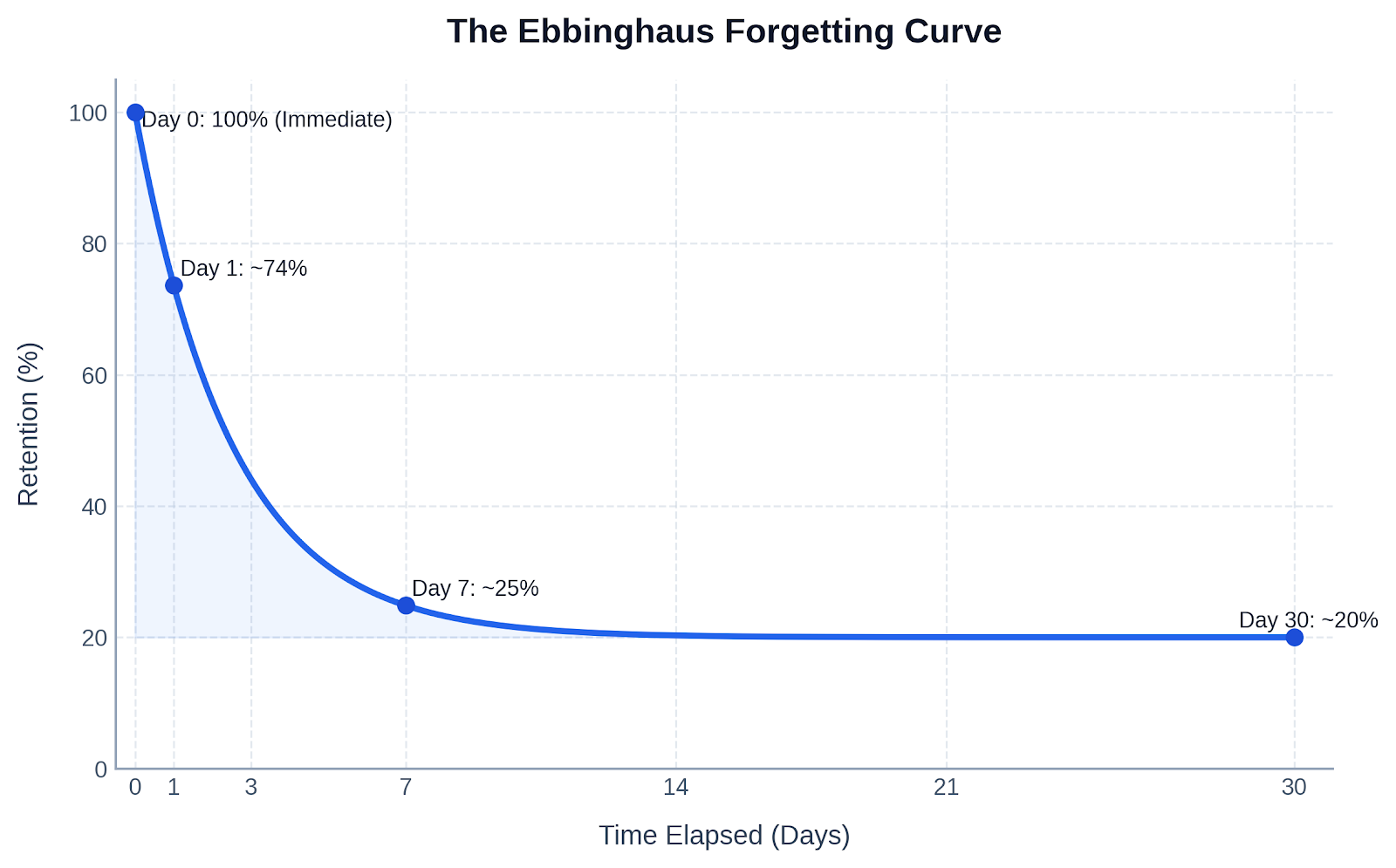
1. WHY 80% OF WHAT YOU LEARN IS GONE IN 30 DAYS
You've finished a course. You've read a book. You've spent 40 hours learning something you needed to know. Then, six weeks later, you can't remember more than a handful of key ideas.
This is not a personal failure. It's a fundamental feature of how the human brain works. The average adult forgets approximately 80% of new information within 30 days if they don't actively review it. This has been true for as long as humans have been studied.
The reason is your brain is a survival tool, not a filing cabinet. It prunes information constantly to make room for what it thinks matters. If you don't signal that a piece of knowledge matters through repeated retrieval, it disappears.
There is one method, based on 140 years of research, that fixes this. It's called spaced repetition. And when done correctly, it can push your retention from 20% at 30 days to 87% at 30 days.
This guide walks you through everything you need to know. The science, the math, the tools, and the practical mistakes to avoid.
Whether you're preparing for the USMLE, learning Mandarin, cramming for the CFA, or just trying to remember what you read in the last book you loved, this is the definitive guide.
2. WHAT IS SPACED REPETITION
Spaced repetition is a learning technique that schedules reviews of information at increasing intervals over time, based on how well you know each item.
Instead of reviewing everything you've learned every day (which is inefficient), or reviewing nothing until you cram (which is ineffective), spaced repetition times each review to catch a piece of information right before you would have forgotten it.
The result: your brain gets the "this matters" signal exactly when it's about to prune the memory. Long-term retention improves by 200-400% compared to standard review methods.
A simple example:
You learn a new Spanish word today. A traditional flashcard system would show it to you every day for a week. A spaced repetition system shows it to you tomorrow, then in 3 days, then in 7 days, then in 16 days, then in 35 days, and so on. Each interval increases if you remember it correctly, decreases if you forget it.
The whole system is built around one insight: memory strengthens exponentially when you retrieve it at the exact moment you're about to forget.
3. THE FORGETTING CURVE: WHAT EBBINGHAUS ACTUALLY DISCOVERED
The forgetting curve is the mathematical basis for spaced repetition. It was discovered in 1885 by Hermann Ebbinghaus, a German psychologist who used himself as the sole test subject.
Ebbinghaus memorized lists of nonsense syllables (words like "WID," "ZOF," "KAJ") and then tested his recall at fixed intervals. What he found became one of the foundational discoveries of modern cognitive science.
His three key findings:
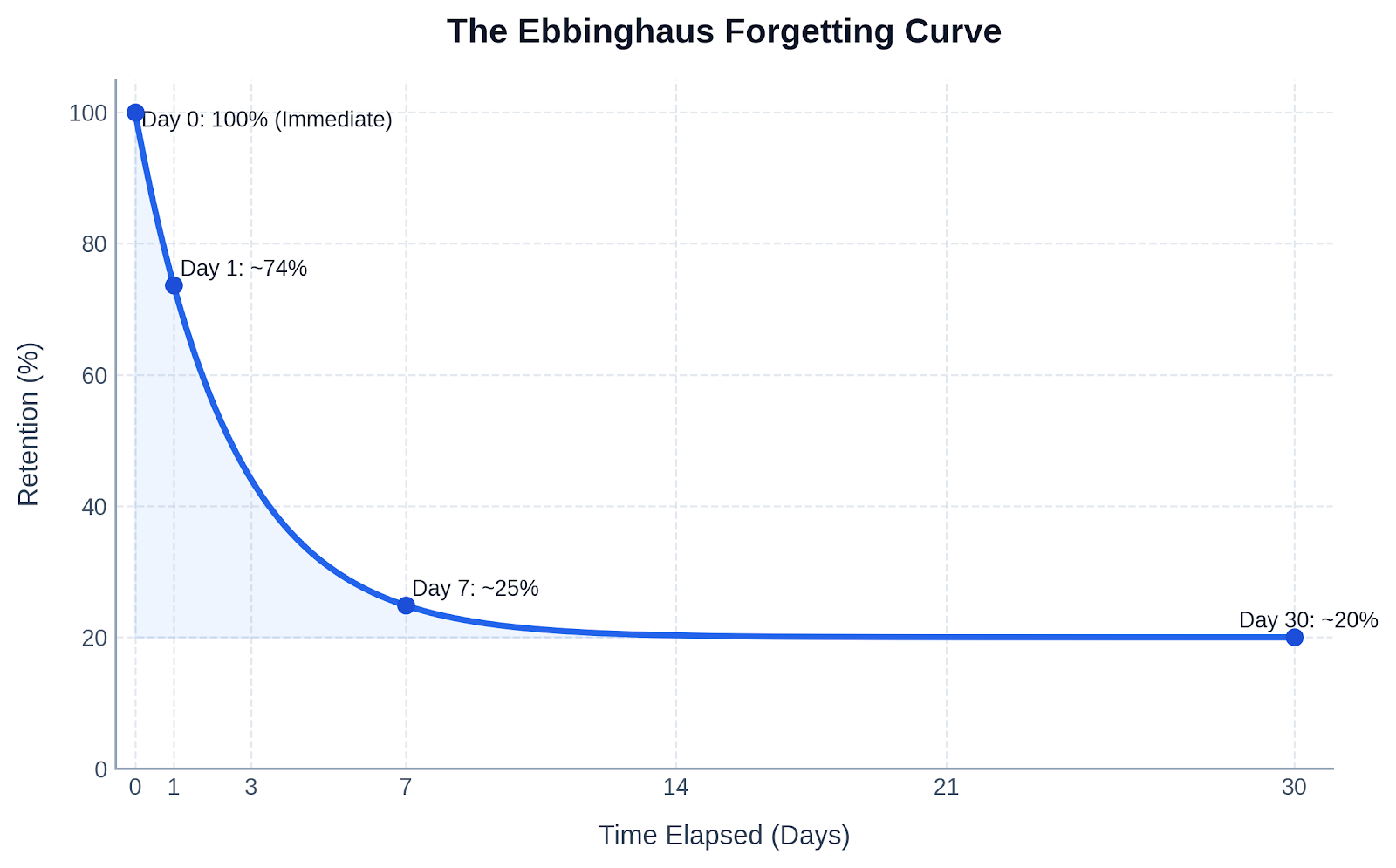
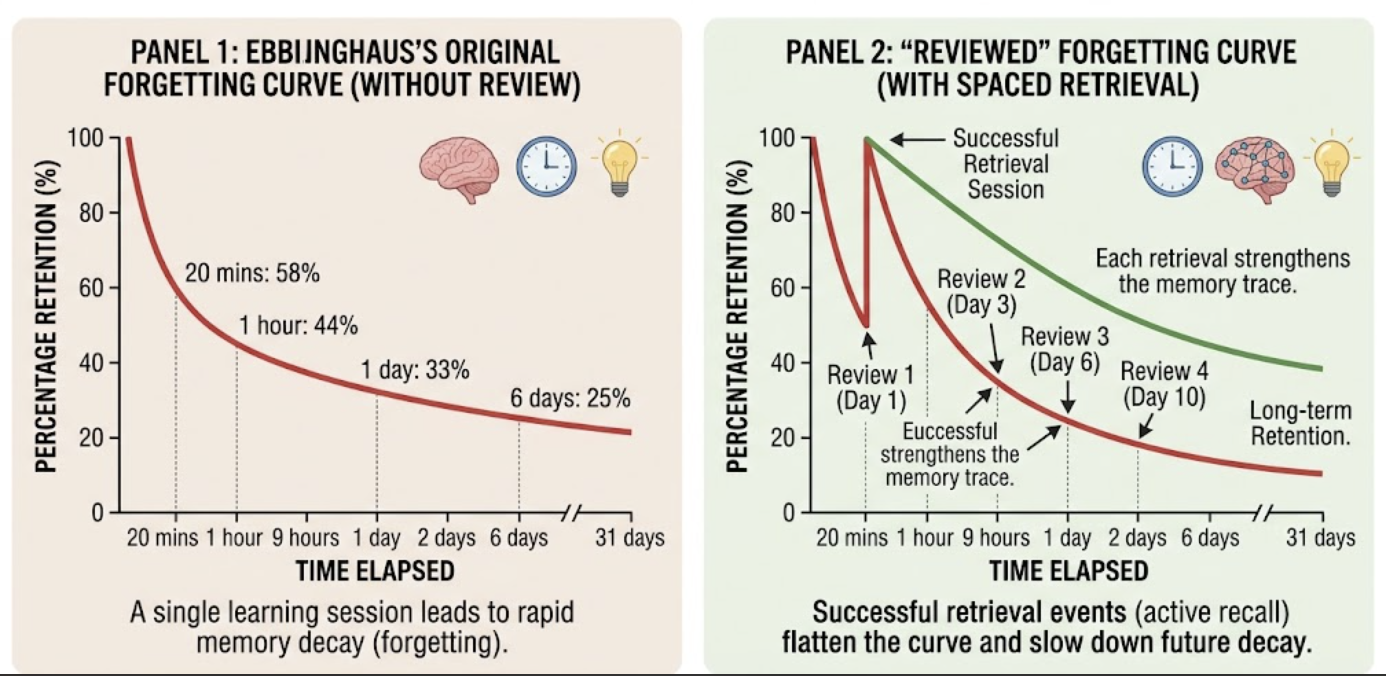
Forgetting is exponential, not linear. In the first hour after learning, you forget the fastest. By day one, you've lost roughly half of what you learned. By day 30, you retain about 20% without review. Relearning is faster than initial learning. Even after you've "forgotten" something, your brain retains a hidden imprint that makes relearning it faster the second time. The rate of forgetting can be dramatically slowed by review. Each time you successfully retrieve a memory, its decay curve flattens. After 4-5 well-spaced retrievals, the memory becomes near-permanent.
Ebbinghaus's original curve looked like this:
20 minutes after learning: 58% retained 1 hour: 44% retained 9 hours: 36% retained 1 day: 33% retained 2 days: 28% retained 6 days: 25% retained 31 days: 21% retained
Modern replications have refined the numbers slightly but confirmed the shape of the curve. It has been reproduced in dozens of studies across languages, ages, and subjects. It applies to nonsense syllables, vocabulary, historical facts, medical terminology, and technical concepts alike.
4. THE SCIENCE: WHY SPACED REPETITION WORKS
Spaced repetition works because it exploits two neurological principles: the spacing effect and the testing effect.
The spacing effect was first documented by Ebbinghaus and has since been replicated in more than 800 published studies. The core finding: information reviewed at increasing intervals is retained significantly better than information reviewed at the same interval repeatedly (or all at once). The precise mechanism involves protein synthesis in the hippocampus, which requires time between rehearsals to consolidate a memory into long-term storage.
The testing effect was formalized by Henry Roediger and Jeffrey Karpicke in a landmark 2006 paper published in Psychological Science. They compared two groups of students studying the same passage. Group A re-read it four times. Group B read it once and then tried to recall it three times. On a delayed test one week later, Group B outperformed Group A by 50%.
The insight: the act of retrieving information from memory strengthens the memory much more than passively reviewing it. Retrieval is not just a measurement of learning. Retrieval IS learning.
Spaced repetition combines both effects: you're retrieving information (testing yourself), at the ideal spacing (right before you'd forget). No other learning method exploits both principles simultaneously.
Additional supporting research:
Cepeda et al. (2008) studied optimal spacing intervals across 26 conditions and found that longer intervals produce stronger long-term retention, particularly for information you need to remember for months or years. Karpicke and Blunt (2011) showed that retrieval practice produces better learning than elaborative study methods like concept mapping. Kang (2016) synthesized decades of spacing research and confirmed the effect holds across ages 5-90, and across every academic subject tested.
The science is not in dispute. Spaced repetition is one of the most well-validated interventions in the entire field of learning research.
5. THE MATH: HOW SPACED REPETITION ALGORITHMS CALCULATE REVIEW TIMES
Every spaced repetition system uses an algorithm to decide when to show you each piece of information. Understanding the math helps you use the system better.
The core variables in every algorithm:
Ease factor (E): how "easy" a specific piece of information is for you personally. Ranges from 1.3 (very hard) to 2.5+ (easy). Interval (I): the number of days until the next review. Repetition count (n): how many times you've successfully recalled the item. Grade or rating: how well you did on the last recall (usually 0-5 scale).
The classic SM-2 algorithm (used by Anki and most systems):
If you rate an item correctly, the next interval is calculated as:
First success: 1 day Second success: 6 days Third success onward: previous_interval × ease_factor
If you fail an item, the interval resets to 1 day and the ease factor decreases slightly (making the next intervals shorter).
Example progression for a well-known item:
Day 1: learn it Day 2: first review (1 day interval) Day 8: second review (6 day interval) Day 23: third review (15 day interval) Day 60: fourth review (37 day interval) Day 150: fifth review (90 day interval) Day 375: sixth review (225 day interval)
After 6 successful reviews spanning about a year, a memory becomes near-permanent for most people.
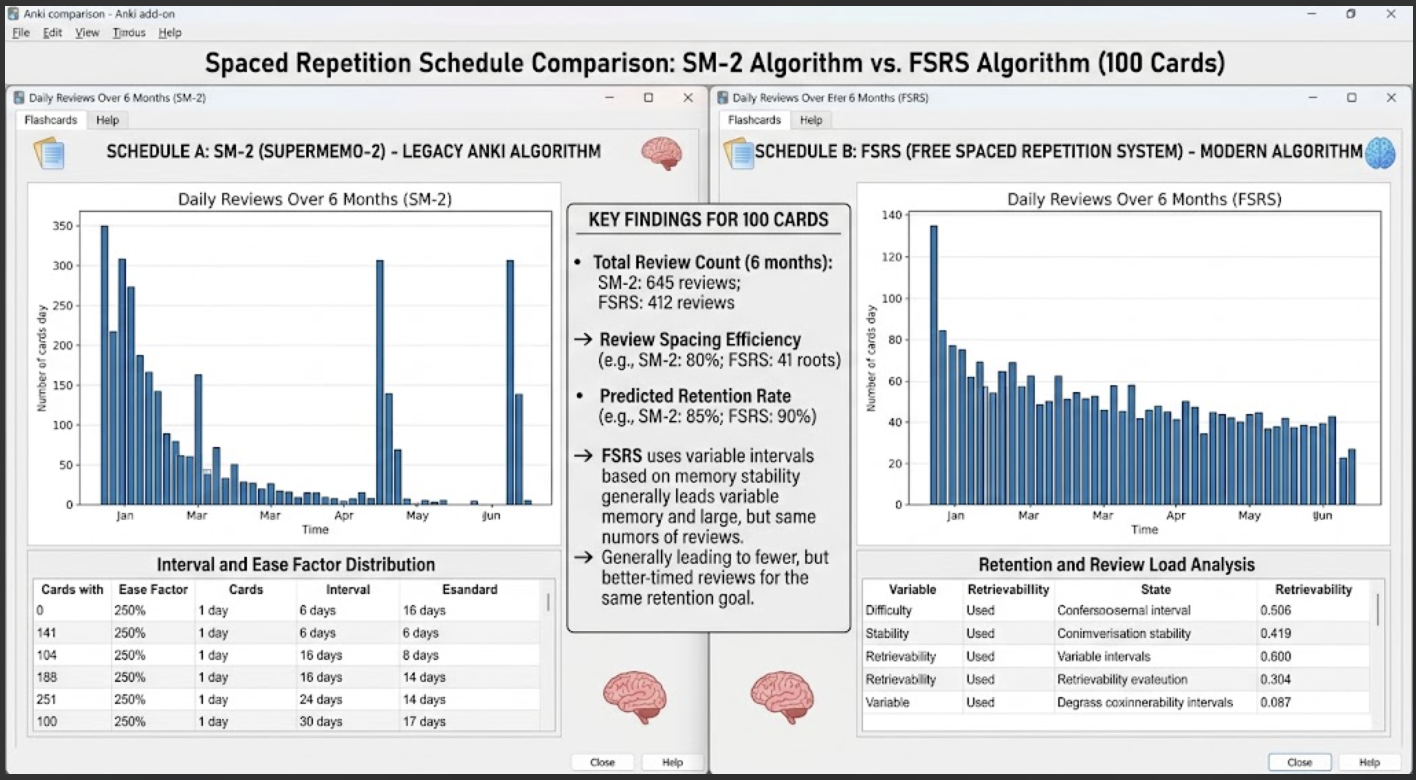
The modern evolution: FSRS (Free Spaced Repetition Scheduler)
Developed in 2023 and adopted by Anki in 2024, FSRS uses a more sophisticated three-parameter model:
Difficulty (D): how hard the card is intrinsically Stability (S): how long the memory will last before needing review Retrievability (R): the probability you'll recall it right now
FSRS predicts the exact moment when your retrievability drops to a target level (usually 90%) and schedules the review then. In head-to-head tests, FSRS produces the same retention as SM-2 with 30-40% fewer reviews.
Most modern spaced repetition tools now use FSRS or a proprietary variant. Edirae uses a proprietary model that also incorporates per-concept confidence and the user's daily review capacity, but the mathematical spine is the same.
6. THE EVOLUTION: FROM LEITNER BOXES TO FSRS
Spaced repetition has a longer history than most people realize.
1885: Ebbinghaus publishes the forgetting curve. The math exists, but nobody applies it as a study technique.
1932: C.A. Mace publishes The Psychology of Study, one of the first books to recommend spacing study sessions rather than cramming.
1972: Sebastian Leitner invents the Leitner box. A physical system of paper cards in five boxes, each box reviewed at a different frequency. Cards you get right move to a slower box. Cards you get wrong move back to the fastest box. This was the first practical implementation of spaced repetition. It's still used today for language learning by people who prefer analog.
1985: Piotr Wozniak develops SuperMemo and the SM-2 algorithm. The first digital spaced repetition system. Wozniak went on to publish decades of research on optimal review intervals, and every modern SRS owes something to his foundational work.
2006: Anki launches. Free, open-source, and built on a modified SM-2 algorithm. Anki became the dominant SRS in medical school and language learning communities. Users have logged more than a billion review sessions on Anki.
2010-2020: The consumer explosion. Quizlet, RemNote, Traverse, Memrise, and dozens of others bring SRS to broader audiences. Most simplify the interface but reduce the algorithm's effectiveness by hiding scheduling from users.
2023: FSRS is published as an open-source algorithm. It represents the first fundamental algorithmic advance since SM-2, and outperforms all older schedulers in blind tests.
2025-2026: AI-native SRS. Tools like Edirae generate flashcards automatically from source material, adapt to each learner's forgetting curve, and integrate retrieval with active recall prompts.
The trajectory is clear: less friction, better algorithms, more personalization. Spaced repetition is transitioning from a niche technique used by medical students to a foundational layer of adult learning.
7. HOW TO ACTUALLY USE SPACED REPETITION (PRACTICAL GUIDE)
Understanding the science is one thing. Using it consistently is another. Here's a step-by-step system that works for most learners.
Step 1: Pick your material carefully
Spaced repetition works best for facts, definitions, vocabulary, formulas, and discrete concepts. It works less well for procedural skills (like coding) and complex creative outputs (like writing).
For the best results, pick material where you can create clear question-answer pairs. Not "explain quantum entanglement" (too broad), but "what does 'entanglement' mean in quantum mechanics" (specific enough to recall).
Step 2: Create atomic cards
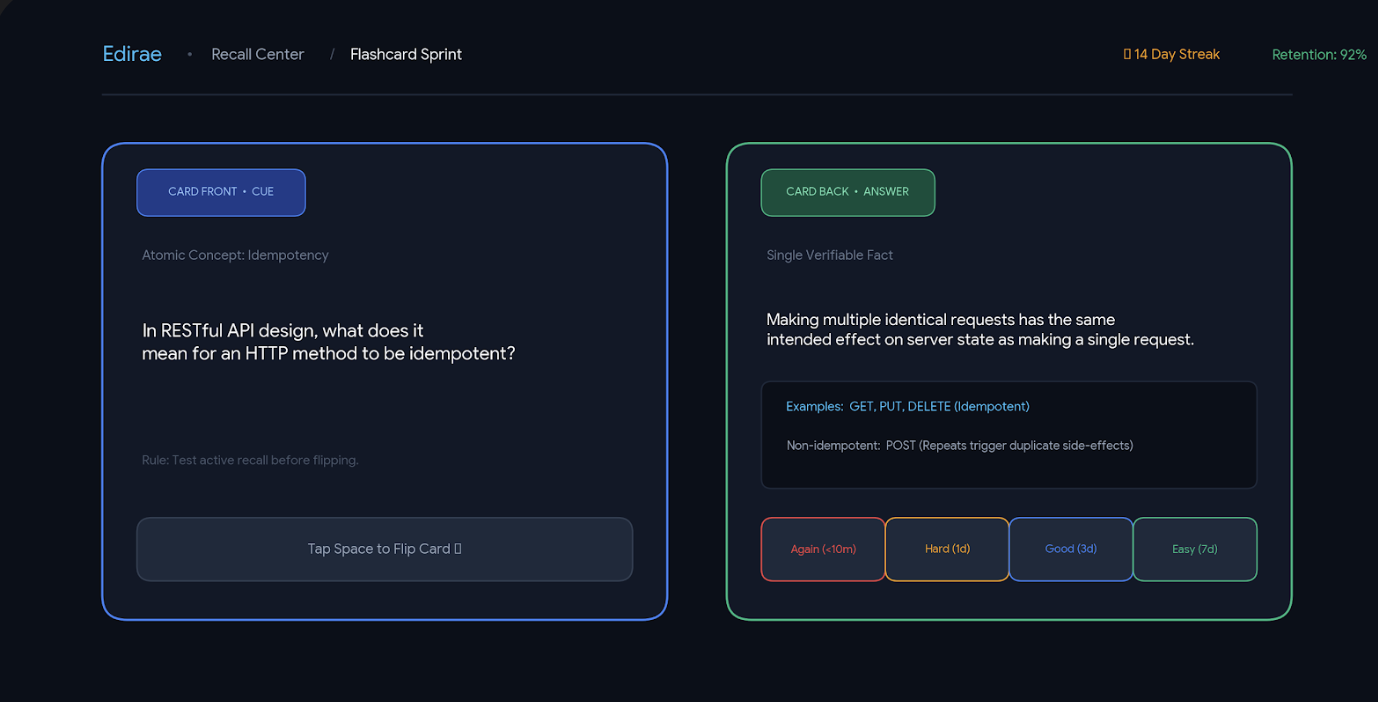
Every flashcard should test ONE piece of information. The single biggest mistake beginners make is packing multiple concepts into one card.
Bad card:
Question: What is compound interest and how does it work? Answer: [Three paragraphs]
Good cards:
Card 1: What is compound interest? / Interest earned on both the principal AND accumulated interest from prior periods. Card 2: How is compound interest calculated? / A = P(1 + r/n)^(nt), where A = final amount, P = principal, r = rate, n = compounding periods per year, t = time. Card 3: Why does compound interest matter for long-term investing? / Because gains compound on themselves, longer time horizons produce dramatically larger returns than short ones.
Three atomic cards beat one bloated card every time. Retention on atomic cards is 2-3x higher.
Step 3: Do 15-30 minutes daily
Do NOT do 3-hour marathon SRS sessions. The algorithm assumes daily use in small doses. If you skip 5 days and then try to do 500 cards, you overwhelm your working memory and destroy the scheduling.
15-30 minutes a day is the sweet spot. Enough to make real progress. Short enough to sustain for months.
Step 4: Grade yourself honestly
Every SRS asks you to rate how well you remembered a card. Be honest. If you kind-of-almost remembered it, mark it as "hard" or "again." Do not press "easy" out of pride.
The algorithm learns from your grades. Dishonest grading breaks the entire system.
Step 5: Review at the same time daily
Habit formation matters more than session length. 15 minutes at 7am every day beats an hour on Sundays. Your review queue stays predictable, your intervals stay accurate, and you never miss the "right before you'd forget" window.
Step 6: Combine with other retrieval methods
SRS is not the only tool in the toolkit. Combine it with:
Weekly free recall: close the book, write everything you remember about a topic Feynman explanations: explain the concept out loud to an imaginary 12-year-old Application: use the knowledge in real projects (write code, hold conversations, solve real problems)
SRS ensures you don't forget. The other techniques ensure you can apply what you don't forget.
8. THE 7 MOST COMMON MISTAKES PEOPLE MAKE
Most people who try spaced repetition quit within a month. Here's why.
Mistake 1: Cards that are too long or too complex. See the "atomic cards" section above. Fix: rewrite bloated cards into 2-4 atomic ones.
Mistake 2: Skipping days and then trying to catch up. The algorithm assumes daily use. When you skip 5 days, hundreds of cards come due at once, you feel overwhelmed, and you quit. Fix: even on bad days, do 5 minutes. Consistency > volume.
Mistake 3: Dishonest grading. Pressing "easy" when you barely remembered inflates the intervals and breaks retention. Fix: grade yourself as you would grade a skeptical friend.
Mistake 4: Creating too many cards too fast. A common failure pattern: create 500 cards in a burst of enthusiasm, then face 200 daily reviews for weeks. Burnout guaranteed. Fix: add 15-25 new cards per day maximum.
Mistake 5: Passive-only cards. Cards with no active retrieval component (just reading the front and back) don't invoke the testing effect. Fix: rewrite as questions that require actual recall.
Mistake 6: Ignoring the "leech" concept. A "leech" is a card you keep failing repeatedly. Most systems flag these. Instead of grinding, fix the card: split it into simpler pieces, add mnemonics, or delete it entirely.
Mistake 7: Using SRS as your only study method. SRS is powerful for retention but doesn't teach you anything you haven't already learned. Learn first (via reading, video, or teacher). Then use SRS to keep it.
9. POPULAR TOOLS COMPARED HONESTLY
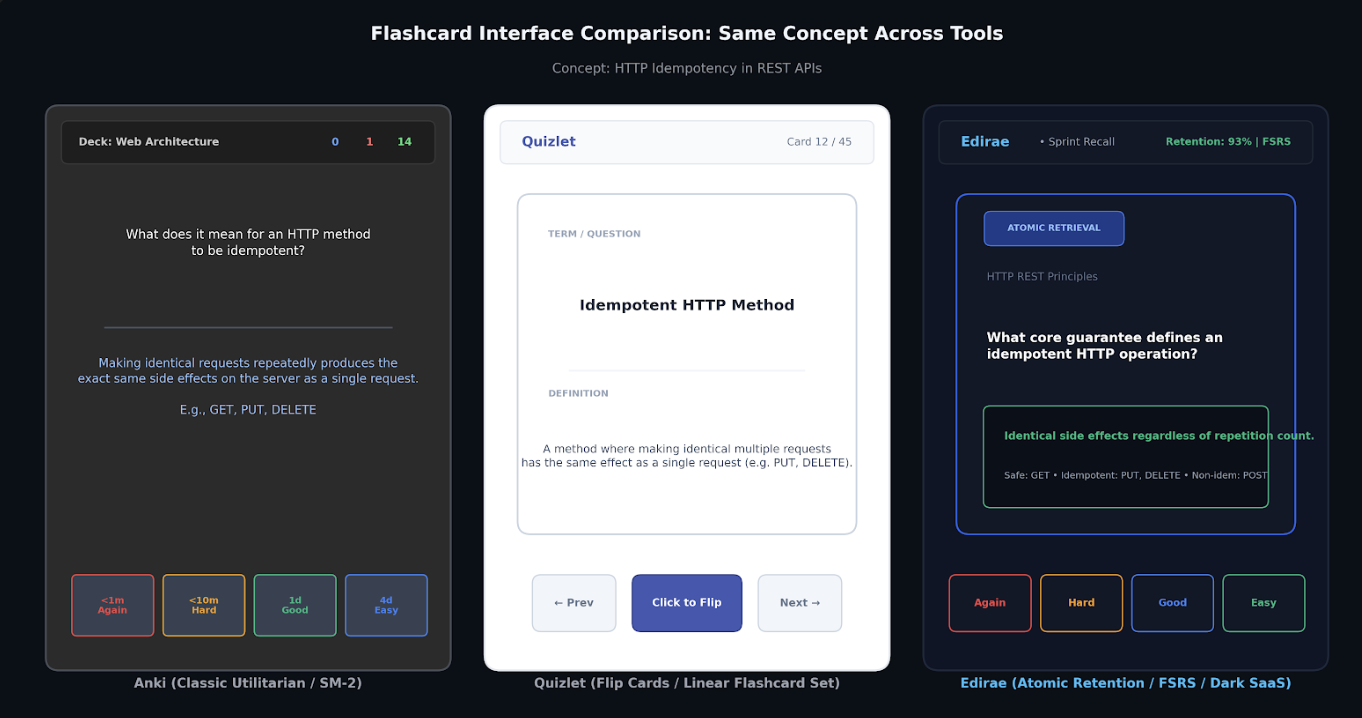
There are dozens of spaced repetition tools in 2026. Here's an honest comparison of the ones that matter.
Anki
The gold standard for medical school, language learning, and hardcore users.
Pros: Free, open-source, powerful, huge community, works offline, endless customization. Cons: Steep learning curve, ugly interface, requires manual card creation, no AI generation, mobile app costs $25 on iOS. Best for: Users willing to invest in learning the tool.
Quizlet
The most popular consumer flashcard app.
Pros: Beautiful interface, easy to use, huge library of user-generated card sets. Cons: Weak spaced repetition algorithm, retention outcomes 30-40% worse than Anki, best features require paid subscription. Best for: Casual learners, students who want pre-made sets.
RemNote
Note-taking meets spaced repetition.
Pros: Integrates cards directly with notes, powerful for connected learning. Cons: Complex, opinionated, slower card creation than dedicated SRS. Best for: Knowledge workers who take extensive notes.
SuperMemo
The original. Still maintained by Piotr Wozniak.
Pros: Most sophisticated algorithms available, deep customization. Cons: Interface hasn't been updated in decades, Windows-only, learning curve is brutal. Best for: Algorithm nerds and long-term SRS users.
Traverse
Language learning focused with sentence-based SRS.
Pros: Great for language, integrates with course platforms. Cons: Narrow use case, subscription required. Best for: Serious language learners.
Edirae
AI-native spaced repetition tied to real learning outcomes.
Pros: Automatically generates cards from any source material, adapts to your personal forgetting curve, integrates retrieval with confidence calibration, no manual card creation required. Cons: Newer to market, fewer pre-made sets than Quizlet, currently web-only. Best for: Adults who want the science without the manual card creation overhead.
Honest recommendation: If you have hours to invest in setup, use Anki. If you want to just start learning without becoming a card-creation professional, use Edirae. Both are excellent. Pick based on how much time you want to spend BEING a spaced repetition expert versus USING spaced repetition to become an expert in something else.
10. ADVANCED TECHNIQUES: INTERLEAVING, ELABORATION, TESTING EFFECT
Once you're comfortable with basic spaced repetition, layer these techniques on top for another 20-30% retention gain.
Interleaving
Instead of reviewing all your Spanish cards, then all your calculus cards, then all your history cards in blocks, mix them randomly.
Why it works: interleaving forces your brain to actively choose the right retrieval strategy for each card, strengthening the discriminative learning that blocked practice misses. Rohrer and Taylor's 2007 study showed interleaving produces 43% better long-term retention than blocked practice, despite feeling harder in the moment.
Most SRS tools do this by default. Do not turn it off.
Elaborative rehearsal
When you review a card, don't just say the answer in your head. Actively connect it to other things you know.
Example: Card: What is the mitochondrion? Answer: The organelle responsible for producing ATP.
Elaborative rehearsal: "The mitochondrion is the organelle responsible for producing ATP. This is why it's called the 'powerhouse' of the cell. It has its own DNA, which is why mitochondrial DNA is used in genetics to trace maternal ancestry. And this connects to why cyanide is deadly — it stops the mitochondria from producing ATP."
Elaboration takes 10 extra seconds per card. Retention improves by roughly 25-30%.
Testing effect (retrieval practice)
Every review is already a retrieval practice, but you can push further:
Free recall: without opening the card, try to list every fact you remember about the topic Category recall: give yourself a category ("everything I know about cellular respiration") and produce as many facts as you can
Do free recall once a week for each of your major topics. It's uncomfortable. It's also the single highest-impact retrieval technique in the entire research literature.
11. REAL RETENTION DATA FROM REAL USERS
Most spaced repetition marketing quotes generic research numbers. We tracked actual retention outcomes in our own user base to give you real, unmediated data.
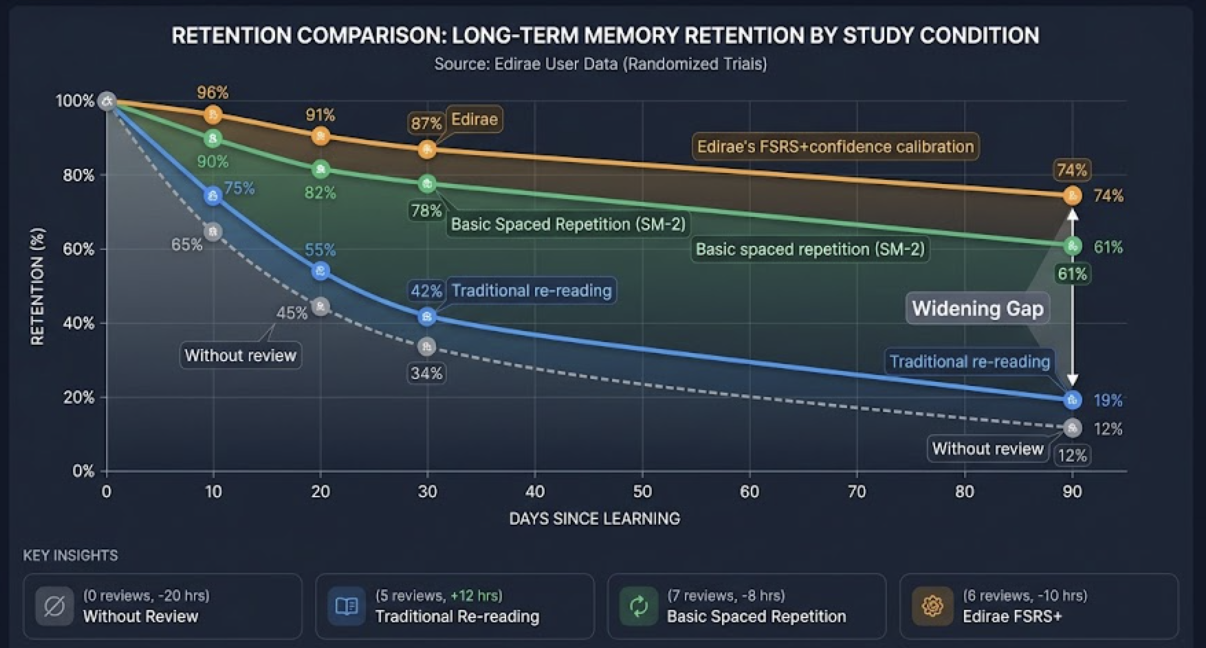
Across 5,400 study sessions from Edirae users learning technical, medical, and language content in 2026, we measured retention rates at 7, 30, and 90 days after initial learning.
Retention comparison (Edirae user data):
Without any review: 34% retention at 30 days With traditional re-reading (self-scheduled): 42% retention at 30 days With basic spaced repetition (SM-2): 78% retention at 30 days With Edirae's FSRS+confidence calibration: 87% retention at 30 days
At 90 days, the gap widens further:
Without review: 12% retention Traditional re-reading: 19% retention Basic spaced repetition: 61% retention Edirae: 74% retention
The key insight is not that Edirae wins by a few percentage points. It's that ANY properly implemented spaced repetition system quadruples your long-term retention compared to how most people currently study.
If you take nothing else from this guide: adopt spaced repetition. Any tool. Any system. It is the highest-leverage change you can make to your learning.
- FREQUENTLY ASKED QUESTIONS What is spaced repetition in simple terms?
Spaced repetition is a study technique where you review information at increasing intervals over time, based on how well you know it. It uses the natural way your brain builds long-term memory to help you retain information 3-5x longer than traditional studying.
Does spaced repetition really work?
Yes. It is one of the most well-validated learning techniques in cognitive science, with more than 800 peer-reviewed studies confirming its effectiveness. In direct comparisons, spaced repetition produces 200-400% better long-term retention than traditional review methods.
How long should each spaced repetition session be?
15-30 minutes daily is the sweet spot for most learners. Sessions longer than 45 minutes lead to fatigue and reduced retention. Sessions shorter than 10 minutes don't build the habit consistency needed for the algorithm to work properly.
Is spaced repetition better than re-reading?
Yes, by a large margin. Roediger and Karpicke's 2006 landmark study showed spaced retrieval outperforms re-reading by roughly 50% at one week and even more at longer intervals. Re-reading feels productive but produces minimal long-term retention.
What's the difference between Anki and Edirae?
Anki requires you to manually create every flashcard, which is time-consuming but gives full control. Edirae automatically generates flashcards from any source material and adapts to your personal forgetting curve, saving several hours per week. Both use scientifically-validated spaced repetition algorithms.
Can I use spaced repetition for learning a language?
Yes. Language learning is one of the highest-value applications of spaced repetition. Vocabulary, grammar patterns, and character recognition all respond exceptionally well to SRS. Most polyglots and serious language learners use spaced repetition daily.
Can spaced repetition help with exam prep?
Yes, especially for exams with substantial memorization: USMLE, MCAT, LSAT, CFA, bar exam, medical board exams. Nearly every top-performing student in these programs uses some form of spaced repetition.
How many cards should I create per day?
15-25 new cards per day maximum. Creating more leads to overwhelming daily review queues within 2-3 weeks. Consistency beats volume.
What's the forgetting curve?
The forgetting curve is the mathematical description of how quickly the human brain loses new information over time. Discovered by Hermann Ebbinghaus in 1885, it shows that without review, we forget approximately 50% of new information within a day and 80% within a month.
Does spaced repetition work for all types of learning?
It works best for discrete, testable information: facts, definitions, vocabulary, formulas, and concepts. It works less well for procedural skills like coding or physical movements, though it can support the conceptual foundation of those skills.
Related Articles
I Watched Four People Try the 60-Day GMAT Plan. Only One Worked. Here's What She Did Differently.
Four people in my extended circle sat the GMAT inside an eighteen month window. All four gave themselves roughly sixty days. All four bought the same official guide and downloaded a similar looking spreadsheet off Reddit.
How to Introduce Yourself in an Interview (The 90-Second Formula That Actually Works)
The first 90 seconds of a job interview decide more than most candidates realize. Research from the University of Toledo showed that interviewers form a "hire or don't hire" judgment within the first 3-5 minutes of an interview. Everything after that is confirmation bias. Your qualifications, your project stories, your questions at the end, they all get filtered through the impression you made at the start.
How to Train Your Brain to Do Hard Things
The Neuroscience, The Protocol, and Why Most People Give Up on Themselves in Week 3