THE PROBLEM
You wanted to learn a new language this year. It's September and you haven't opened Duolingo since March.
You wanted to switch careers. You started the course. You made it to week 3. You never went back.
You wanted to write the book, launch the side project, get in shape, learn to code, start meditating, read more.
You didn't. Not because you didn't want to. Not because you're lazy. Not because you're broken.
Because your brain is doing exactly what it evolved to do. And nobody taught you how to work with that instead of fighting it.
This article is about how to actually train your brain to do hard things. Not motivation-poster advice. Actual neuroscience with a practical protocol you can start tomorrow.
WHAT "HARD" ACTUALLY MEANS TO YOUR BRAIN
The word "hard" gets thrown around loosely, but your brain interprets it very specifically. When you sit down to do something difficult, three things happen at the neurological level:
1. Your amygdala flags it as a threat. The amygdala, that almond-shaped structure in your limbic system, evolved to keep you alive from predators. It cannot distinguish between physical danger and psychological difficulty. When you open a textbook full of concepts you don't understand, or sit down to write when the words aren't coming, or start a workout your body isn't ready for, your amygdala fires. It floods you with cortisol. Your prefrontal cortex, the part responsible for executive function, working memory, and problem-solving, begins to shut down.
You feel anxious. You feel distracted. You feel dumb. That's the shutdown happening in real time.
2. Your dopamine system predicts low reward. Dopamine isn't a pleasure chemical. It's a "seek more of this" chemical. It's produced in anticipation of reward. When you scroll TikTok, you get consistent small dopamine hits, so your brain learns "this is a good use of time." When you try to do something hard, the reward is delayed and uncertain. Dopamine drops. Your motivation collapses. You reach for the phone. Not because you're weak, but because your brain is running a chemical cost-benefit analysis you can't override with willpower alone.
3. Your working memory overflows. Working memory holds 4-7 pieces of information at once. Hard tasks demand more slots than easy tasks. When you try to hold a new concept, remember what you just read, connect it to prior knowledge, and monitor your own confusion at the same time, you exceed capacity. Your mind blanks. You lose the thread. You start again.
These three responses combined explain almost everything about why hard things feel so bad and why most people never do them.
The good news: every one of these responses is trainable.
THE FIVE REAL REASONS PEOPLE GIVE UP
Before the protocol, understand what you're actually fighting. It's not laziness. It's five specific patterns.
1. Fear of feeling stupid. Being bad at something feels worse when you're 30 than when you're 12. As an adult, you've built an identity around competence. Being visibly incompetent, especially in public, triggers a shame response your brain treats as a social threat. Most adults stop learning new hard things around this age for exactly this reason.
2. Wrong difficulty calibration. People start too hard. They pick "read one book a week" when their baseline is zero. They start "run 5 miles a day" when they haven't run in years. The gap between where they are and where they're trying to be is so wide that the brain triggers full-scale threat response every time they attempt it. Most give up in 10-14 days.
3. No feedback loop. Without regular signal that you're making progress, dopamine stops firing. Your brain concludes the effort isn't producing results. Even when it is. This is why so many people quit right before their breakthrough.
4. Environmental resistance. The environment you learn in matters more than the willpower you bring. If your phone is on the desk, if the material is disorganized, if the room is uncomfortable, you're spending willpower on things that shouldn't cost willpower. You run out before the work is done.
5. Wrong identity. Most people try to change what they do without changing who they think they are. "I want to write more" is a preference. "I am a writer" is an identity. Behavior aligned with identity becomes automatic. Behavior fighting identity requires constant effort.
Each of these is fixable. Here's how.
THE 8-STEP PROTOCOL FOR TRAINING YOUR BRAIN
Do these in order. Do not skip step 1 for step 4. The order matters.
Step 1: Start smaller than feels reasonable
If you can't focus for an hour, don't try to focus for an hour. Try 10 minutes. If 10 minutes is too much, try 5. If 5 is too much, try 90 seconds.
The goal of the first two weeks is not progress on the actual task. The goal is to prove to your amygdala that this activity is safe. That there are no consequences. That you can sit down, do a small thing, and walk away intact.
Once the threat response calms down, you can slowly extend. Your amygdala learns to trust the pattern. Your prefrontal cortex stays online longer each session. This is the actual mechanism.
Rule: The unit of work is whatever your brain does not resist. Nothing more.
Step 2: Anchor to an existing habit
Your brain executes established habits without conscious effort. New behaviors have to be built by attaching them to existing ones. This is habit stacking, and it's more effective than any productivity technique in the popular canon.
Examples:
- After I pour my morning coffee, I open my study material for 10 minutes.
- After I brush my teeth at night, I write 100 words.
- After I close my laptop for work, I do one Anki review session. The existing habit is the trigger. The new behavior gets pulled along by the pattern.
Rule: Never rely on "remembering" to do a new hard thing. Anchor it to something automatic.
Step 3: Reduce cognitive load in advance
Every decision you make before starting the work costs willpower. Every friction point between you and the work costs willpower. You have finite willpower per day. Spend it on the work, not on getting to the work.
Before the session, remove:
- Phone from the room (not just silenced)
- Multiple tabs
- Unclear next steps
- Ambient noise if you're sensitive
- Uncomfortable seating
- Any decision you'll have to make in the moment Prepare:
- The specific material to review
- One clear next action
- A timer set
- Water within reach The goal is that when the anchor triggers, you enter the work without a single willpower-costing decision between you and it.
Rule: Reduce friction to zero. Willpower is for the work itself.
Step 4: Build a feedback loop
Dopamine responds to signal. Without signal, motivation dies. You need to see progress, even if the progress is tiny.
Ways to build feedback loops for hard things:
- Track daily consistency (a simple X in a calendar)
- Measure the actual output (words written, cards reviewed, minutes practiced)
- Take before/after markers (record yourself doing the skill on day 1, again on day 30)
- Share progress publicly on a slow cadence (weekly, not daily, to avoid dopamine spikes) Do NOT rely on outcome metrics too early. If you're trying to write and you track book sales, you'll quit before you finish the first draft. Track effort, not outcome, for the first 90 days.
Rule: Feed your brain small proof of progress at least once a week.
Step 5: Deliberately practice the hard part
Amateur learners spend 90% of their time on what they already know and 10% on what they're weak at. Elite performers do the opposite.
Deliberate practice, the technique used by Olympic athletes and chess grandmasters, focuses training on the specific sub-skill where you're weakest. Not the parts that feel good. The specific gap.
For most hard things, this means:
- Identify the specific concept or skill you keep getting wrong
- Drill it in isolation, in short sessions, with immediate feedback
- Repeat until mastery, then move to the next weakness This is uncomfortable. That is the point. Comfort correlates inversely with learning speed. The parts that hurt while you build them are the parts that stick.
Rule: Aim your practice at the exact place you feel weakest.
Step 6: Use spaced repetition for anything you need to retain
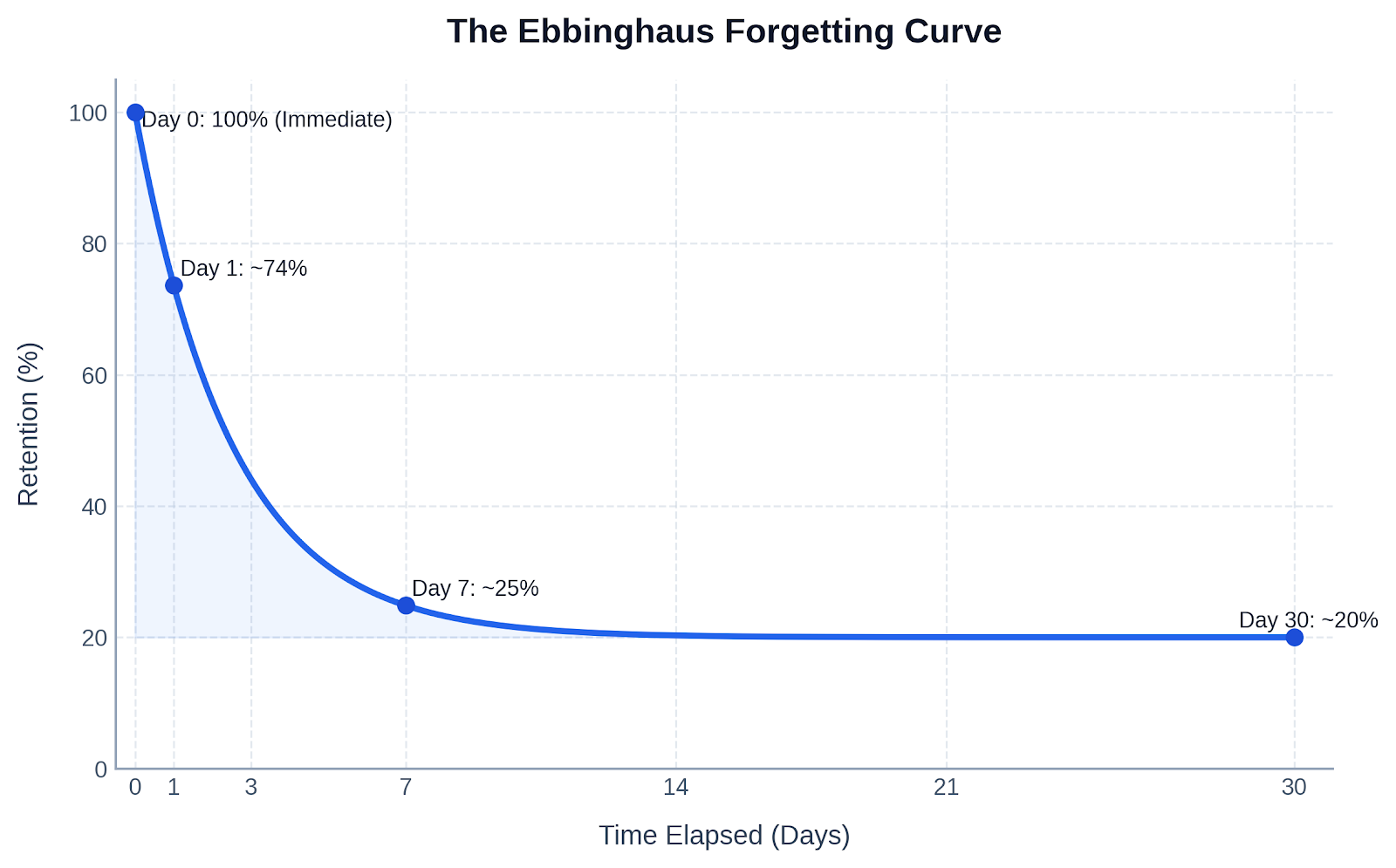
Your brain is a survival tool, not a filing cabinet. It deletes anything you don't retrieve. Without a retention system, most of what you learn from a hard task will be gone in 30 days.
Spaced repetition solves this. Retrieve information at increasing intervals, right before you'd forget. This flattens the forgetting curve and pushes retention from around 20% at 30 days to 87% at 30 days.
Any spaced repetition system works. Anki is the free standard. If you want automation over your source material (books, courses, notes), Edirae is designed to remove the manual card-creation overhead that kills 90% of Anki users.
The point isn't the tool. It's that you cannot skip the retention layer if you want the hard thing to compound over months and years.
Rule: Learning without a retention layer is renting information. Own it via retrieval.
Step 7: Sit with confusion for five extra minutes
Every hard learner hits a wall. You'll read a paragraph three times and it won't click. You'll try to solve a problem and be stuck. The frustration will spike. Your amygdala will scream at you to switch to something easier.
That exact moment is the growth point. Neurologically, that discomfort is the signal that new pathways are being forced open. Your brain builds new connections precisely when the existing ones fail.
Beginners feel confused and switch tasks. People who train themselves to do hard things stay 5 extra minutes. Not an hour. Not a day. Five minutes past the point where they wanted to quit.
That's the muscle. Build it deliberately.
Rule: When you hit the wall, stay 5 more minutes. Just 5.
Step 8: Rest, then repeat
Neuroplasticity, the process by which your brain physically restructures itself through learning, happens during rest and sleep, not during the effort itself.
If you push hard without rest:
- Skills don't consolidate
- Retention drops
- Motivation collapses
- Injury or burnout follows The rhythm for hard-thing training is:
- Short effortful sessions (15-45 minutes)
- Deliberate breaks (5-15 minutes)
- Full night's sleep (7-9 hours)
- One full rest day per week You cannot out-hustle your biology. The people who look like they work harder than you rest more strategically than you.
Rule: Rest is when learning consolidates. Treat it as work, not indulgence.
THE COMMON FAILURE MODES
Even people who know the protocol still fail. Almost always in these five predictable ways.
Failure 1: Trying to change five hard things at once. Every hard change costs willpower. You have a fixed budget per day. Try to install five new hard behaviors simultaneously and you'll fail all five. Pick ONE hard thing. Master the practice. Then add the next.
Failure 2: Measuring outcomes too early. Compound growth is invisible for the first 60-90 days. If you're checking daily whether you feel smarter, stronger, or more skilled, you'll conclude nothing is working and quit. The signal doesn't arrive on day 12. It arrives on day 90.
Failure 3: Skipping the recovery. Grinding harder feels like progress. It isn't. It's the fast path to burnout. Rest is where the actual gains consolidate. The people who look disciplined take real days off.
Failure 4: Waiting for motivation. Motivation is a mood. It follows action, not the reverse. If you wait to feel like doing the hard thing, you'll wait forever. Build the anchor (step 2). Start the session (step 1). The mood catches up.
Failure 5: Not tolerating being visibly bad. Most adults will not learn a new hard thing because they refuse to be publicly bad at it for 6 months. That single refusal is what separates people who compound skills across their life from people who plateau at 30.
If you can tolerate being visibly bad, you can become anyone.
THE UNCOMFORTABLE TRUTH ABOUT WHAT ACTUALLY CHANGES YOU
Here's what nobody tells you.
The specific hard thing you pick barely matters. Machine learning, Mandarin, chess, boxing, writing, coding, painting. What changes you is not the skill. It's the practice of tolerating discomfort while your brain builds new pathways.
After enough hard learning, you become the type of person who no longer treats "difficult" as a stop sign. You start reading it as a signal that something valuable is on the other side.
That's the identity shift, and it's the actual point of training your brain to do hard things. The skill is the setup. The person you become is the payoff.
You stop saying "I can't." You start saying "not yet."
Everything else in your life bends around that shift.
A REAL PROTOCOL FOR THE NEXT 90 DAYS
If you want to actually apply this, here's what to do in the next 90 days.
Days 1-14: Establish the pattern
- Pick one hard thing
- Start with 10 minutes daily
- Anchor to an existing morning habit
- Remove phone and distractions in advance
- Track only that you showed up (X on a calendar) Days 15-30: Extend the sessions
- Increase to 20-30 minutes
- Introduce a weekly review session
- Start using a retention tool for anything memorable
- Notice which parts you avoid — that's where deliberate practice lives Days 31-60: Add deliberate practice
- Identify your weakest sub-skill
- Drill it in short sessions with feedback
- Publish or share something small once a week (accountability + feedback loop) Days 61-90: Compound
- Sessions extend naturally to 45-60 minutes
- Retention system running daily
- Public feedback loop established
- Rest days protected By day 90, doing the hard thing is closer to automatic than to effortful. Not because it got easier, but because your brain rewired to expect it.
FREQUENTLY ASKED QUESTIONS
How long does it take to train my brain to do hard things?
The threat response begins to calm down within 2-3 weeks of consistent short sessions. Real automaticity develops around day 60-90. Meaningful identity change (thinking of yourself as someone who does hard things) generally takes 6 months. The compound benefits are lifelong.
Why do I procrastinate on hard things even when I want to do them?
Because wanting to do something and being neurologically ready to do it are different. Procrastination is your amygdala flagging the task as a threat before your prefrontal cortex can engage. The fix isn't more willpower. It's smaller starting units and lower-friction environments.
Is there any research proving this actually works?
Yes. The core mechanisms come from decades of peer-reviewed research: Ericsson on deliberate practice, Bjork on desirable difficulties, Roediger and Karpicke on the testing effect, Duckworth on grit, Dweck on growth mindset, and Baumeister on willpower depletion. The protocol above operationalizes these findings.
Can I train my brain to do hard things if I'm an adult?
Yes. The idea that adults can't rewire their brains was disproven decades ago. Neuroplasticity persists across the entire human lifespan. The reason adults appear to stop learning hard things isn't biological. It's that adults refuse the discomfort of being publicly bad at something, which is exactly the discomfort learning requires.
What's the difference between discipline and habit?
Discipline is the willpower you spend to force yourself to do something. Habit is what your brain does automatically without willpower. The goal of training your brain is not to become more disciplined. It's to convert enough hard behaviors into habits that you don't need discipline for them anymore.
Should I use a tool to help me?
Yes, but not to replace the work. Tools reduce friction and support retention. Anki or Edirae for retention. Notion or a paper journal for tracking. A timer for session structure. Anything more elaborate is likely procrastination disguised as preparation.
What's the single most important step in this protocol?
Step 1: start smaller than feels reasonable. Almost every failure to do hard things comes from starting too big and triggering full threat response. Start absurdly small. Everything else compounds off that foundation.
How do I know if I'm actually making progress?
Track consistency, not outcomes, for the first 90 days. Consistency is a signal you can trust. Outcomes on hard things move slowly and non-linearly. If you're showing up daily for 60 days and doing the work, you are making progress, whether it feels like it or not.
THE ONE THING TO REMEMBER
You don't need more discipline. You need a better relationship with the discomfort.
The people who look effortless at hard things aren't more talented, more motivated, or more disciplined than you. They've just spent longer training their brain to stop treating difficulty as a threat.
That's the whole training. Do it long enough and hard things become possible for you that most people around you will never attempt.
Start today. Ten minutes. Smaller than feels reasonable. The rest compounds.
Written by Patrick Obafemi, founder of Edirae. Edirae is the retention layer used by adults learning hard technical, medical, and professional skills. If you're taking on something hard this year, our 3-day free Pro trial is at edirae.com.
Related guides:
- Stop Losing what you Learn
- The Complete Guide to Spaced Repetition
- The 10 Most Useful Learning Apps in 2026
Related Articles
I Watched Four People Try the 60-Day GMAT Plan. Only One Worked. Here's What She Did Differently.
Four people in my extended circle sat the GMAT inside an eighteen month window. All four gave themselves roughly sixty days. All four bought the same official guide and downloaded a similar looking spreadsheet off Reddit.
How to Introduce Yourself in an Interview (The 90-Second Formula That Actually Works)
The first 90 seconds of a job interview decide more than most candidates realize. Research from the University of Toledo showed that interviewers form a "hire or don't hire" judgment within the first 3-5 minutes of an interview. Everything after that is confirmation bias. Your qualifications, your project stories, your questions at the end, they all get filtered through the impression you made at the start.
The Complete Guide to Spaced Repetition
The most comprehensive guide to spaced repetition. Learn the science behind why it works, how to use it, and the tools that make it easy. Written by learning practitioners, not marketers.